
A lot of buyers ask this question the wrong way. They ask, “Is the Chinese machine as good as the European one?” That sounds simple, but it misses the real buying point. The better question is this: which machine makes the most sense for the target market, the target customer, and the support system behind it? In this category, the benchmark small telescopic loader names are still mostly European, while Japanese brands are stronger in adjacent compact categories such as wheel loaders and compact equipment rather than in a broad lineup of true small telehandlers. Kubota and Yanmar both highlight compact equipment and wheel loaders, while brands such as JCB, Weidemann, Avant, Schäffer, and MultiOne show dedicated compact telehandlers or telescopic wheel loader solutions.
That matters because buyers are often not comparing one exact machine type. In Europe, the comparison may be between a compact telehandler like the Weidemann T4512 or JCB 525-60, an articulated telescopic loader like the Avant 800 series, or a telescopic wheel loader like the Schäffer 6680 T-3 or Weidemann 2080T. Chinese suppliers, including Nicosail, may use names like telescopic arm loader or telescopic boom loader for machines that sit somewhere between those categories. So before talking about price or quality, the first job is to match the machine architecture to the real job: pallet handling, bale work, landscaping, yard loading, municipal work, or rental use.
Why this comparison matters now
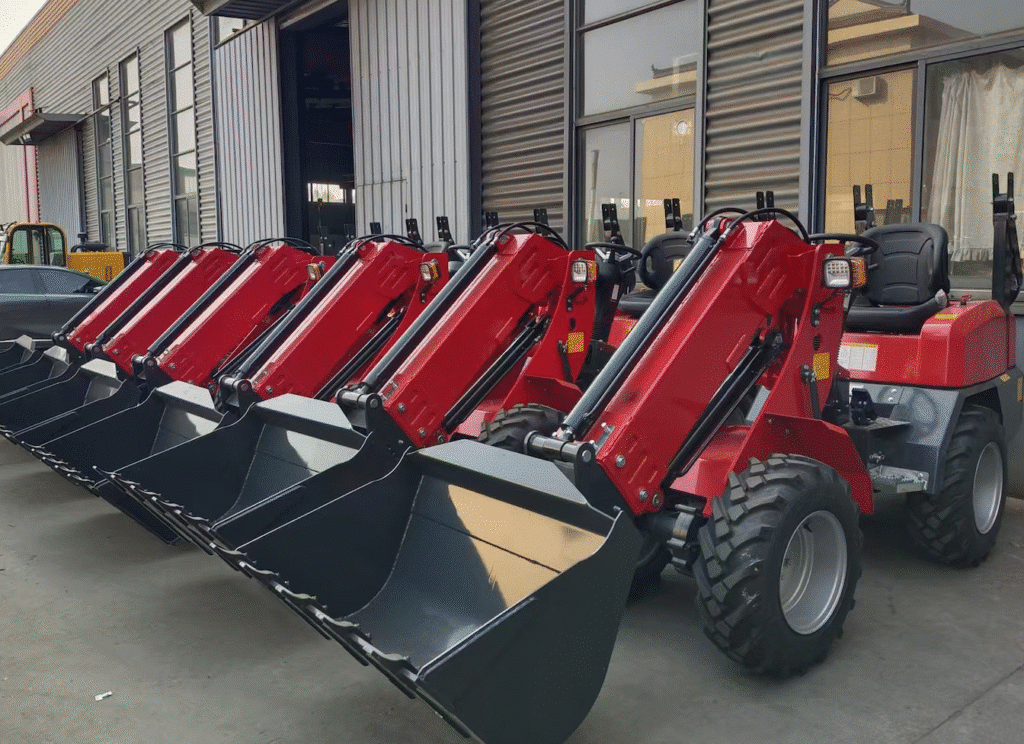
This comparison matters more than ever because more buyers are trying to balance three things at once: lower acquisition cost, tighter emissions and safety rules, and faster delivery. Chinese factory-direct suppliers are getting more attention because they openly position themselves around cost-effectiveness, OEM supply, and customization. Nicosail, for example, describes itself as a manufacturer integrating R&D, production, and sales, and it promotes factory-price agent margins, on-demand customization, and third-party inspection. That is exactly the kind of message that attracts importers, dealers, and private-label buyers.
At the same time, Europe and North America are not getting easier for casual exporting. The European Commission says machinery placed on the EU market before 20 January 2027 must comply with Machinery Directive 2006/42/EC, while the EU’s non-road mobile machinery rules set Stage V emissions limits for these engines. In the United States, EPA Tier 4 remains the nonroad diesel benchmark. That means the buying decision is no longer only about steel and hydraulics. It is also about paperwork, emissions hardware, declarations, labels, and service readiness in the destination market.
First, make sure the machines are really comparable
This is the part many people skip. A small telescopic loader in Europe may be a very compact telehandler, a tele wheel loader, or a compact articulated loader with telescopic boom. Those machines overlap, but they are not identical. The Weidemann T4512, for example, is a very compact telehandler with a lift height of 178.62 inches, payload of 2,756 pounds, width of 61.57 inches, and height under 78.74 inches. JCB’s 525-60 Hi-Viz is bigger, with a low overall height of 1,890 mm, a narrow width of 1,840 mm, a 2,500 kg maximum lift capacity, and 6 m lift height. Avant’s 800 series sits in a different style of machine again, offering up to 1,900 kg lift capacity and 3.5 m lift height in a compact articulated format.
That is why “Chinese vs European” is often too broad. The real comparison is closer to this: Chinese compact telescopic boom loader vs European compact telehandler or telescopic wheel loader, depending on the application. If the end user mainly loads pallets, stacks materials, and works in very tight buildings, a compact telehandler comparison is more accurate. If the job is more mixed yard work, bucket work, snow, light construction, and attachments, then a telescopic wheel loader or articulated telescopic loader may be the better benchmark.
Where Chinese small telescopic loaders usually win
The first clear Chinese advantage is upfront buying cost and channel margin. Nicosail openly says agents buy at factory prices with “over 50% profit,” and it promotes OEM supply and customization. On the same site, one listing snapshot shows a 4,600 lb ZL918 telescopic boom loader with Kubota D1105 diesel engine and a sale price of $9,600. That does not mean every Chinese loader costs that amount, and it definitely does not mean it is directly comparable to a JCB or Weidemann spec-for-spec. Freight, taxes, homologation, attachments, and destination-market compliance can change the real landed cost a lot. But it does show why Chinese machines get so much attention from dealers and importers: the entry price can be low enough to leave real room for margin.
The second Chinese advantage is flexibility. Nicosail says it offers over 20 models to meet regional needs, plus customization on demand and third-party inspection. For dealers, that is a serious point. A factory that can change decals, color schemes, options, and market-specific details is often easier to build into a private-label or semi-private-label business. European brands are usually stronger on brand value and standardization. Chinese factories are often stronger on flexibility. For some distributors, that is exactly the right trade.
The third Chinese advantage is simplicity of the sales logic. Factory-direct buyers are usually not paying for the same level of dealer overhead, showroom cost, or premium brand position. That can make Chinese machines attractive for price-sensitive owner-operators, developing-market distributors, and dealers building an aggressive entry-level range. For those buyers, the question is not whether a Chinese loader feels exactly like a top European loader. The question is whether it is reliable enough, profitable enough, and documented well enough to work in the intended market. Nicosail fits that conversation naturally because it positions itself around cost-effective machinery and export-oriented supply rather than prestige branding.
Where Japanese and European alternatives usually win
European alternatives usually come out ahead in four areas: machine refinement, operator environment, dealer support, and resale confidence. JCB says its Loadall range offers world-beating build quality, unrivalled comfort, and high residual values. That is exactly how premium European brands sell these machines: not just as loaders, but as long-term assets with better support and stronger resale logic. For rental fleets and larger contractors, that message matters a lot because the machine has to earn money not only while it works, but also when it is traded out.
Schäffer makes the same point in a more technical way. Its 6680 T-3 uses a 55 kW Deutz engine, Stage V aftertreatment, hydrostatic four-wheel drive, ECO mode, and a 20/40 km/h hydraulic quick gear. In Schäffer’s own brochure, the 6680 T-3 is presented as a professional-class machine with an SCV-Plus cab focused on ergonomics, space, and all-round visibility. That kind of detail is not only brochure language. It usually shows up in the daily feel of the machine: smoother controls, lower fatigue, better visibility, cleaner cab finish, and stronger buyer confidence in the used market.
Weidemann sits in the same camp. Its 2080T tele wheel loader emphasizes protected hydraulic lines, planetary axles, and economical working, while the T4512 focuses on compact dimensions and meaningful payload in a small package. That tells a buyer something important: European makers are often selling a very polished package around stability, durability, and operator usability, not only a low base price. That is usually why they cost more.
Japanese alternatives usually enter this discussion differently. In this exact category, Japanese brands are more visible in compact wheel loaders, compact construction equipment, and engine supply than in a wide list of true small telehandler models. Kubota highlights wheel loaders in its construction machinery lineup. Yanmar’s compact equipment lineup highlights wheel loaders and other compact equipment, and Yanmar also supplies engines into European loader makers such as Thaler, including telescopic wheel loader applications. So when buyers say “Japanese alternative,” they are often really talking about three things: a Japanese compact loader, a machine powered by a Japanese engine, or a European loader with Japanese power. Those are not the same decision.
Why the engine badge does not tell the full story
A lot of buyers get stuck on engine names. Kubota engine, Yanmar engine, Kohler engine, Deutz engine. Those names matter, but not as much as many people think. The reason is simple: a good engine inside a poorly integrated machine will still create headaches.
That is easy to see from the official specs. Nicosail’s ZL918 listing uses a Kubota D1105 diesel. Manitou’s ULM 412 H uses a Yanmar engine. Another Manitou compact telehandler, the MT 930 H, uses a Kubota engine. MultiOne’s 8.4 TurboS uses a Kohler-based power unit and is compliant with Stage V and Tier 4 Final. In other words, the engine brand appears across different countries and price levels. So the real buying question is not “Does it have a Japanese engine?” The real buying question is “How well is the whole machine put together around that engine?” That includes cooling layout, hose routing, service access, electronics, axle match, hydraulic tuning, and after-sales parts support.
That is also why it is risky to assume a Chinese loader with a Kubota or Yanmar engine is automatically equal to a European loader with the same engine family. It might be good. It might be very good. But the shared engine badge alone does not prove equal durability, equal control feel, equal loader geometry, or equal resale. The engine is only one piece of the machine.

Compliance, certification, and export risk
For importers, this is often the most important section of the whole comparison. The EU says machinery placed on the market before 20 January 2027 must comply with the Machinery Directive, and Stage V sets the emissions side for non-road mobile machinery. In the US, EPA Tier 4 still matters for nonroad diesel engines. So the smart buyer does not stop at “Can this machine be shipped?” The smart buyer asks, “Can this machine legally and smoothly enter my market with the correct engine, declaration, labeling, manuals, and safety configuration?”
This is where European brands usually feel safer. They are built around the compliance expectations of their home markets. JCB’s own Stage V guide shows how real this is in daily operation: Stage V machines use DPF systems, and repeated interruption of regeneration can lead to a required manual regeneration that may take around 45 minutes. JCB also notes that Stage V machines above 19 kW now need a DPF as part of the aftertreatment system. That is a useful reminder that compliance is not just a paper exercise. It changes how the machine behaves in the field.
Chinese suppliers can absolutely ship compliant machines, but buyers should never assume. The exact engine version, aftertreatment package, guarding, lighting, operator instructions, and declaration set must match the destination market. This is why a cheap-looking offer can become expensive very fast. One missing document, one wrong engine calibration, or one careless label can delay customs, registration, resale, or dealer acceptance. That is not a “China problem” only. It is a buying-discipline problem. But it hits factory-direct buying much harder when the importer does not ask enough questions before payment.
Attachments, hydraulics, and day-to-day versatility
This is one area where European brands have built a very strong advantage over time. Avant says it offers over 200 attachments. MultiOne says it has over 170 original attachments and markets the loader as a machine that transforms in seconds. Weidemann also positions its tele wheel loaders as all-rounders with a wide range of suitable attachments. That matters because a small telescopic loader rarely earns money from one job only. It loads, lifts, sweeps, grabs, moves pallets, clears snow, handles bales, and does yard work. A mature attachment ecosystem makes the machine easier to sell, easier to rent, and easier to justify to end users.
Chinese brands can still be very competitive here, especially for common tools like buckets, forks, grabs, and simple hydraulic attachments. But the big difference is usually ecosystem depth and documentation. European brands tend to have a cleaner attachment story, more standardized coupling systems, and a broader branded library of proven applications. Chinese factories are often more flexible on custom requests, but the buyer may need to define the coupler standard, hose routing, auxiliary flow requirements, and spare parts planning more carefully at the order stage.
Parts, service, and downtime risk
This is where many low-price deals either become very smart or very painful.
JCB says its dealer network is by the customer’s side for advice, demos, and service support. Avant offers dealer search around the world. Weidemann provides dealer search for telehandlers and telescopic wheel loaders. MultiOne says it has a worldwide parts and service distribution network, with distributors trained for maintenance and parts assistance. That does not mean every dealer in every country is equally strong. But it does mean the support structure is part of the product.
Chinese factory-direct buying works differently. Nicosail highlights free technical support and third-party inspection, which are both useful. But a smart importer should still lock in the spare-parts list, recommended opening order of wear items, service manuals, wiring diagrams, hydraulic schematics, and response times before the first container ships. European alternatives often cost more because a chunk of that price is paying for the support system around the machine. Chinese machines can still be the better deal, but only when the buyer intentionally builds that support layer instead of assuming it will somehow appear later.
Electric models and future direction
Europe is clearly pushing harder here. Weidemann already offers the electric T4512e telehandler, and JCB offers the 525-60E electric telehandler. JCB says that model provides zero emissions of CO2, NOx, and particulates at point of use and near-silent operation, while Weidemann emphasizes its 96 V lithium-ion setup, compact dimensions, lift height, stability, and all-wheel steering. That tells buyers something important: premium European makers are not only defending the diesel category. They are already building the next one.
Chinese small telescopic loader export listings are still mostly diesel-centered, and Nicosail’s visible telescopic boom loader snapshot is diesel with a Kubota D1105. For many markets, that is still perfectly fine. But if the target customers are city contractors, indoor material handlers, municipalities, or low-noise rental users, European brands currently look more mature in the electric direction.
Which type of buyer should choose which route
For importers and dealers who want price room, private label flexibility, and aggressive market entry, a Chinese supplier can make a lot of sense. That is especially true when the local market is still building brand preference in this segment or when the dealer wants to create its own badge. Nicosail is a reasonable brand to consider in that situation because it openly supports OEM supply, customization, and third-party inspection instead of pretending to be something it is not.
For rental fleets, the math is usually different. Rental businesses care a lot about uptime, operator friendliness, predictable parts, and resale. That usually pushes the decision toward better-established European alternatives, especially where dealer coverage is already strong. JCB’s focus on residual value and local backup is aimed right at that type of buyer.
For farm owners, landscapers, municipalities, and contractors who keep the machine for years and do a lot of the maintenance themselves, the answer depends on how price-sensitive the purchase is and how available local support will be after delivery. If the budget is tight and the buyer is comfortable managing parts and service actively, a well-specified Chinese machine can be a very practical solution. If the buyer wants minimum friction, easier resale, and a stronger attachment ecosystem, Europe still has the cleaner offer.
Why Nicosail is worth considering
Nicosail is worth considering not because it magically beats every European loader. It does not need that story. It is worth considering because it plays a different game. The brand presents itself as a factory-oriented, export-minded supplier with cost-effective machinery, OEM capability, customization, and third-party inspection. For dealers and importers who care about landed-cost control and market-specific configuration, that can be a strong business advantage.
The smart way to evaluate Nicosail is simple. Do not ask whether it feels exactly like a premium JCB, Avant, Weidemann, or Schäffer. Ask whether the machine can do the target jobs, whether the spec matches the market, whether the parts package is clear, whether the documentation is complete, and whether the margin left after freight and support still makes sense. When those boxes are checked, Nicosail can be a practical and profitable option, especially for buyers who do not need to pay premium-brand money for every unit they bring in.
FAQ
Are Chinese small telescopic loaders always cheaper?
Usually the upfront price is lower, especially in factory-direct deals, but the real comparison should include freight, duties, attachments, compliance work, spare parts, and local setup. Nicosail’s own site shows how strongly Chinese suppliers compete on price and margin, but that does not make every landed deal automatically cheap.
Are Japanese brands direct competitors in this exact segment?
Sometimes yes, but often only partly. Japanese brands are very strong in compact equipment and wheel loaders, and Japanese engines are widely used, but many of the most visible dedicated small telehandler and telescopic wheel loader options in this class are European.
Do European machines really hold value better?
They often do, especially in markets with mature dealer networks and brand recognition. JCB explicitly markets high residual values and local backup as part of its value story.
Is a Japanese engine enough reason to buy a machine?
No. A Japanese engine is a good sign, but it is not the whole machine. Integration, cooling, hydraulics, electronics, and after-sales support matter just as much.
What should an EU importer check first?
The machine’s conformity package, emissions configuration, and exact documentation for the destination market. The EU requires machinery placed before 20 January 2027 to comply with Machinery Directive 2006/42/EC, and Stage V applies on the emissions side for this category.
Are electric options already real in this category?
Yes. Weidemann and JCB both offer electric compact telehandler solutions, which is a strong sign that the segment is moving beyond diesel-only thinking.

Final thoughts
The real comparison is not “China bad, Europe good,” and it is not “Europe overpriced, China unbeatable” either. A Chinese small telescopic loader usually wins on acquisition cost, dealer margin, and customization flexibility. A European alternative usually wins on machine refinement, support structure, attachment ecosystem, compliance confidence, and resale logic. Japanese brands matter strongly in engines and adjacent compact loader categories, but the purpose-built benchmark in small telescopic loaders still leans heavily European.
That is why the smartest buyers do not ask which one is “best” in the abstract. They ask which one fits the business model. For private-label import, margin-driven distribution, and price-sensitive owner-operators, a brand like Nicosail can be a smart option when the spec and paperwork are handled carefully. For rental fleets, heavy daily use, and markets where resale and dealer support matter most, the Japanese/European route still has a strong advantage. That is the comparison that actually helps buyers make money instead of just winning an argument.