1. Quick Summary: Telescopic Loader vs Skid Steer – Who Is Each For?
Before diving into details, here’s the short version.
Choose a Chinese small telescopic loader if:
- Jobs need reach and height: loading trucks, stacking pallets, reaching over walls or into barns.
- Work is more about lifting and placing, not aggressive digging.
- Ground surfaces are often paved, farmyards, warehouses, or stable ground.
- Operator comfort and visibility are important (farmers, yard operators, warehouse logistics).
- Need a machine that looks “less aggressive” and more like a small loader than a construction skid steer.
Choose a Chinese skid steer loader if:
- Jobsites are very tight and space is limited.
- Work is heavy on attachments (breaker, planer, auger, trencher, cold planer, brush cutter, etc.).
- Ground is rough, muddy, and changing all the time (construction, demolition, rental).
- Machines need to be multi-purpose in a rental fleet or for a contractor doing many different jobs.
- Operators are used to the skid steer driving style, or Western brands are being replaced with lower-cost Chinese alternatives.
In simple terms:
- Telescopic loader = reach, height, visibility, stability
- Skid steer = compact size, agility, powerful hydraulics for attachments

2. What Is a Small Telescopic Loader?
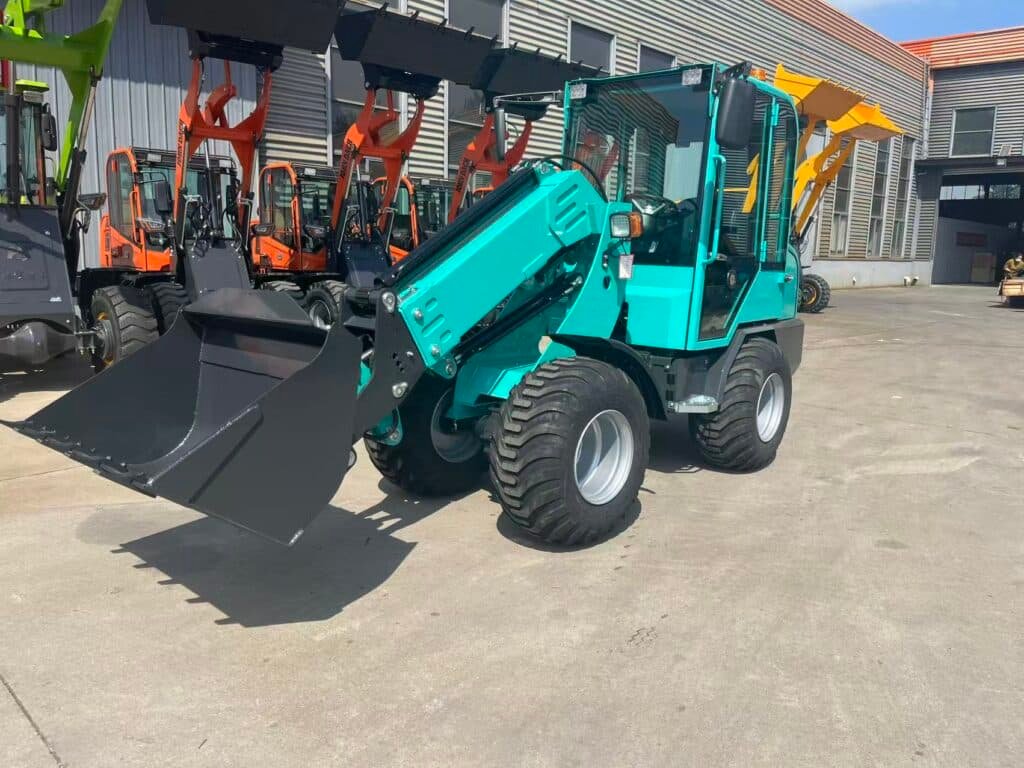
A small telescopic loader is basically a compact wheel loader with a telescopic boom.
Instead of a short fixed arm, the boom can extend outwards, similar to a telehandler, but on a smaller chassis.
Key Features
Most Chinese small telescopic loaders in the 1–3 ton range typically offer:
- Compact wheel loader-style frame
- Telescopic boom for extra reach and lifting height
- Bucket, pallet forks, bale grab, and light attachments
- Articulated steering (machine bends in the middle), giving good turning radius
- Diesel engine, usually Chinese or well-known brands (Kubota, Yanmar, Perkins – depending on model and market)
- Hydrostatic drive, often with 4-wheel drive
- Enclosed cab or ROPS/FOPS canopy, depending on configuration
Strengths of a Small Telescopic Loader
- High reach in a small machine
Ideal for stacking pallets in barns, loading trucks from one side, or loading feed into mixers.
Operators can reach higher and further than with a standard mini wheel loader. - Excellent visibility
Operator sits sideways, with a broad view of the front working area.
This is very comfortable for farm work and yard logistics. - Gentle on the ground
Articulated steering and larger tires are gentler on concrete and asphalt compared with the scrubbing action of a skid steer.
This matters a lot for farmyards, warehouse yards, and paved industrial areas. - Stable when lifting
With proper design, telescopic loaders can be very stable, especially at low to mid extension.
This makes them suitable for farmers and yard workers who are not “heavy machinery specialists”. - Lower noise and more “friendly” look
Many customers (especially farmers and small businesses) perceive a telescopic loader as less aggressive and easier to accept than a skid steer, especially in residential or mixed-use areas.
Weak Points of a Small Telescopic Loader
- Not a demolition machine
Telescopic loaders are not ideal for very heavy digging, demolition, or ramming work.
The telescopic boom has more moving sections, so it needs to be protected from abuse. - Limited attachment flow (compared to skid steer)
Hydraulics are usually sufficient for common farm attachments, but not always for high-demand tools like big cold planers or large mulchers. - Side stability at full reach
Any telescopic boom, when fully extended and turned sideways, loses stability.
This is normal physics, but operators must be trained and the machine must have a solid safety design. - Slightly larger turning circle than a skid steer
Still compact, but not as “spin on the spot” as a skid steer.

3. What Is a Skid Steer Loader?
A skid steer loader is a compact machine with fixed frame and independent left/right wheel drive.
It steers by skidding the wheels or tracks, which gives it very tight turning ability.
Chinese skid steers are now common in 0.6–1.0 m³ bucket sizes and are popular with contractors and rental companies.
Key Features
Typical Chinese skid steer loaders offer:
- Very compact overall size
- Fixed boom arms (radial or vertical lift)
- A front quick-attach for many kinds of attachments
- Either wheel type or track type (compact track loader)
- High-flow and standard-flow hydraulics options on better models
- Enclosed cab with heating/AC on higher configurations
Strengths of a Skid Steer
- Extreme maneuverability
Can turn in place, perfect for very tight jobsites, indoor work, or urban areas. - Attachment powerhouse
Skid steers are attachment platforms.
Augers, trenchers, cold planers, hammers, sweepers, brush cutters – all of these are common and well-designed for skid steer mounting. - Great for aggressive work
Good for demolition, digging, grading, backfilling, and rough handling.
The boom design and frame are built with harsh conditions in mind. - Familiar to many operators
Many operators in North America, Europe, and Australia already know skid steers from big brands.
Switching to a Chinese skid steer is then more about trusting the quality than learning a new working style.
Weak Points of a Skid Steer
- Tough on ground surfaces
The way skid steers turn tends to scrape and damage asphalt, concrete, and paving.
This can cause complaints from customers if used in nice yards or new driveways. - Less reach and lift height compared to a telescopic loader
A skid steer can lift and dump into a truck, but cannot reach as far into a farm building or over obstacles like a telescopic boom can. - Cab comfort and visibility vary a lot by brand
Lower-end imports sometimes have cramped cabs and weaker visibility.
For rental and daily-use customers, this matters more than many buyers expect. - Higher risk if inexperienced operator
Skid steers can move quickly and turn sharply; inexperienced operators may hit walls, vehicles, or people if not trained well.
4. Direct Comparison: 7 Key Questions to Decide
Instead of memorizing long spec sheets, it is easier to look at 7 simple questions.
1) How tight is your jobsite?
- Very tight indoor areas, narrow city sites, tiny driveways
→ Skid steer wins. It turns on the spot and can work where articulated loaders struggle. - Medium space farmyards, warehouse yards, building material depots
→ Both can work, but telescopic loader may be more comfortable and gentle on the ground.
2) How high do you really need to lift?
- Need to stack 2–3 levels of pallets, load tall trucks, reach into mixers or over fences
→ Telescopic loader is better. The extending boom gives more lift height and forward reach. - Most work is ground-level: loading small trucks, digging, backfilling
→ Skid steer is enough, and often cheaper for this kind of work.
3) What ground conditions do you work on?
- Mostly concrete, asphalt, paved yards, slab floors
→ Telescopic loader is kinder to the surface. - Mud, demolition sites, uneven construction ground, winter slush
→ Skid steer (especially a track loader version) handles this better and offers stronger traction.
4) How important are attachments and hydraulics?
- Need to run heavy-duty attachments daily
- Cold planer, stump grinder, big mulcher, heavy hydraulic hammer
→ Skid steer with strong auxiliary hydraulics is the better platform.
- Cold planer, stump grinder, big mulcher, heavy hydraulic hammer
- Mainly buckets, pallet forks, bale grabs, light clamps
→ Telescopic loader is perfectly fine, often more pleasant to operate for this type of work.
5) Who will operate the machine?
- Farm staff, warehouse workers, general labor
→ Telescopic loader is easier to understand and often feels more “normal” to them. - Experienced construction operators, rental customers used to skid steers
→ Skid steer is familiar, faster and more productive in tough construction applications.

6) How about maintenance, parts, and downtime?
Both telescopic loaders and skid steers from China can be reliable if the factory is serious about:
- Welding quality
- Hose routing and protection
- Hydraulic component selection
- Boom structure design
- Engine and cooling system layout
Telescopic boom adds extra sliding sections and hoses; this needs good design and assembly.
Skid steer has high drive loads through chains, pumps, and motors; this needs robust components.
Working with a manufacturer like Nicosail, which focuses on mini excavators, compact tracked loaders, and skid steers, can reduce risk because:
- Machines are designed for export markets (Europe, North America, Australia).
- CE/EPA and other certifications are considered from the design stage.
- Documentation and parts lists are prepared for foreign customers.
7) What is the budget and profit model?
- Dealers / distributors:
If the plan is to rebrand Chinese machines and sell at a premium, the machine must not just be cheap.
It must be “good enough” to protect the brand – especially boom welds, paint quality, hoses, and main hydraulic components. - Farmers / contractors buying directly:
Total cost of ownership matters more than the lowest price.
A slightly more expensive machine from a better factory can be cheaper over 5–7 years.
In many cases, a Chinese skid steer ends up slightly more expensive per unit than a similarly sized Chinese telescopic loader, mainly due to stronger hydraulics and drivetrain demands.
However, if attachment work is heavy, the skid steer will still be more profitable.
5. Chinese Machines vs Western Brands: What’s Different in Reality?
When buyers hear “Chinese small telescopic loader” or “Chinese skid steer”, two questions often come up:
- Is the quality good enough?
- Are the documents and certificates real?
Price Level
Chinese factories offer roughly:
- 30–50% lower buying cost than many big Western brands, depending on configuration and engine choice.
- The gap is smaller when high-end engines and pumps are specified, but still noticeable.
Components
Many better factories now use:
- Well-known engines (Kubota, Yanmar, Perkins, etc., depending on model and market)
- Quality hydraulic pumps/valves from recognized suppliers
- Branded hoses and fittings
- Laser-cut and robot-welded structures in key areas
Lower-end factories cut costs on:
- Steel thickness and grade
- Boom structure design
- Hose routing and protection
- Welding quality and NDT (non-destructive testing)
- Paint and surface treatment
This is where a factory like Nicosail tries to differentiate:
By using more robust structures, better hoses, and proper EOL (end-of-line) testing to ensure a machine is ready for export use, not just local use.
Certification and Documentation
For Europe, North America, and Australia, buyers care about:
- CE / UKCA
- EPA / Tier 4 Final (for the USA)
- ROPS / FOPS tests
- Operator manuals and parts catalogues in English
Serious factories will:
- Provide test reports and certificates
- Offer clear nameplates and markings
- Give complete documentation
Buyers are wise to ask for:
- Sample certificates
- Serial number photos
- Videos showing the actual machine with labels installed
6. Real-World Use Cases: Which Machine Wins in Each Scenario?
A) Farm and Smallholding
Typical jobs:
- Moving feed, silage, and manure
- Stacking hay bales and pallets
- Cleaning barns and animal areas
- Loading mixers, small trucks, or trailers
Better choice: Small Telescopic Loader
Why:
- Higher reach for stacking and loading into tall feeders
- Gentler on concrete and stable floors
- Better visibility when working near animals and buildings
- Feels more like a “farm machine” than a construction skid steer
A Chinese small telescopic loader from a factory like Nicosail, with a diesel engine, 4×4, cab, pallet forks, and standard agricultural attachments, is often exactly what mid-sized farms need.

B) Construction & General Contracting
Typical jobs:
- Loading and carrying materials
- Backfilling foundations
- Site cleanup
- Demolition support
- Working with hammers, augers, sweepers
Better choice: Skid Steer Loader
Why:
- Can work in very tight spaces around buildings
- Handles heavy-duty attachments better
- Strong traction in mud and rough ground
- Common on most construction sites, so operators know how to use it
A Chinese skid steer loader with proper boom structure, good auxiliary hydraulics, and CE/EPA compliance can replace more expensive Western brands in many applications if quality is controlled well.
C) Rental Business
Rental companies care about:
- Machines that are easy to understand for renters
- Less damage from misuse
- Versatility with many attachments
- Easy, quick maintenance and repair
Two types of rentals exist:
- Construction and demolition-focused rental
→ Skid steer is more attractive; customers expect them. - Farm, estate, light construction, landscaping rental
→ Mix of small telescopic loaders and skid steers works well.
Telescopic loaders are easier for beginners; skid steers satisfy power users.
A rental fleet that includes Chinese skid steers and telescopic loaders can offer good profit if:
- Machines are robust
- Spare parts are available
- Protective structures (guards, hose protections, light guards) are well designed
D) Landscaping & Garden Work
Typical jobs:
- Moving soil, gravel, mulch
- Preparing lawns and gardens
- Small grading jobs
- Installing paving, fences, and small structures
Here, it depends on the main type of customer:
- Heavy hardscaping, urban jobsites, frequent attachment use → Skid steer
- Garden centers, small landscapers, private estates, narrow pathways on grass → Small telescopic loader
(because of lower ground damage and better visibility)
7. Buying from China: What to Check Before Ordering
Whether the decision is “Chinese small telescopic loader” or “Chinese skid steer loader”, a few practical checks can save a lot of trouble later.
For Small Telescopic Loaders
- Boom Structure and Welding
- Check photos/videos of the boom at different angles.
- Look closely at welds around high-stress areas: base, telescopic section, and bucket linkage.
- Ask if the factory uses welding WPS and does NDT or proof load tests.
- Telescopic Section Play and Wear Pads
- There should be guides/wear pads to control side play.
- Ask how these pads are adjusted and replaced.
- Excess play leads to inaccurate lifting and faster wear.
- Hydraulic Hose Routing
- Hoses to the boom and telescopic section must be protected from branches, pallets, and forks.
- Ask for zoomed-in photos or video of hose routing.
- Lift Capacity and Stability Test
- Ask the factory to send a video with scales or known load weight.
- Ask for load charts if available.
- Request a test showing the machine loading a truck or stacking to maximum height.
- Cab and Controls
- Check operator space, seat quality, lever layout, and visibility.
- Ask what options are available: air-conditioning, heating, radio, camera.
- Engine and Hydraulics Brand
- Confirm the emission standard required for your country.
- Check brand, model, and local support for engine and main pump.
For Skid Steer Loaders
- Boom Type and Strength
- Decide if radial lift or vertical lift is necessary.
- Check boom side plates and weld reinforcement.
- Ask for test videos of aggressive digging and loading.
- Drive System
- Ask if chain drive or direct drive is used.
- Ask how easy it is to adjust chain tension and access drive components for service.
- Hydraulic Flow
- Confirm standard and/or high flow figures.
- Match this with the attachments planned for use (especially planers, mulchers, and hammers).
- Cab Safety and Visibility
- Ask for photos from inside the cab looking out.
- Check door design, side windows, and glass thickness.
- Confirm ROPS/FOPS certification if needed for your region.
- Cooling System
- Skid steers can run hot with attachments.
- Ask how the cooling package is designed and if there is a reversing fan option.
- Maintenance Access
- Ask for videos showing hood opening, side covers, and how to reach filters and batteries.
- Easy access saves hours of labor over the life of the machine.
8. How to Talk to a Chinese Supplier So You Get the Right Machine
Many problems in buying from China come from miscommunication, not from bad intentions.
When discussing a small telescopic loader or skid steer, it helps to:
- Describe the main job in simple words
Example:
“Machine will mainly stack pallets and bales, maximum 1.2 tons, in a farmyard on concrete. Need 3–4 meters stacking height.” - Send photos or short videos of the jobsite
This helps the factory engineer imagine the real work instead of just reading a spec list. - State clearly which attachments will be used
- Bucket only?
- Forks?
- Auger, hammer, planer, sweeper?
The machine’s hydraulic and structural requirements change a lot depending on this.
- Tell them about your customers
Dealers and rental companies should say if customers are farmers, construction contractors, landscapers, or mixed. - Ask for 2–3 recommended models, not 10
Too many options create confusion.
A serious factory will narrow the choice and explain clearly why a certain model fits. - Ask for a full specification and price breakdown
- Base machine
- Attachments
- Spare parts package
- Optional features (AC, high flow hydraulics, quick coupler, etc.)
- Discuss lead time and shipping plan in detail
Many buyers’ pain point is delayed shipment.
Getting a realistic production and shipment timeline upfront prevents lost selling seasons.
9. Where a Brand Like Nicosail Fits In
In the Chinese market, there are many factories building small loaders, telescopic loaders, mini excavators, compact tracked loaders, and skid steers.
Nicosail positions itself as:
- A factory with multiple production lines for compact construction and agricultural machines
- Focused on export markets such as Europe, North America, and Australia
- Offering mini excavators, compact tracked loaders, skid steer loaders, and related compact machines
For buyers considering Chinese small telescopic loaders and skid steers, working with such a factory brings a few advantages:
- Better understanding of dealer and rental business models
- Awareness of certification, quality inspection, and after-sales support
- Ability to customize outlook and branding, which is important for dealers rebranding the machines in their local market
Rather than acting like a trading company, a factory-based supplier like Nicosail can usually provide:
- Real engineering feedback on whether a telescopic loader or skid steer suits the job
- Test videos from their own yard and test benches
- More consistent production control over welds, hydraulics, and assembly
The goal is not just to sell a machine, but to make sure that the dealer, farmer, or contractor uses it with confidence and minimal trouble.

10. FAQ – Chinese Small Telescopic Loader vs Skid Steer
1) Are Chinese small telescopic loaders reliable?
Chinese small telescopic loaders can be reliable if:
- The factory uses good steel and welding procedures
- The telescopic boom is designed with proper safety margins
- Hoses, pins, and wear pads are chosen with export use in mind
The key is who built it, not just the country.
Factories like Nicosail that focus on export standards are generally a safer choice than unknown small workshops.
2) Is a skid steer always more powerful than a telescopic loader?
Not always, but usually a skid steer is more aggressive in how it works.
Its strong auxiliary hydraulics and compact design make it better for:
- Demolition
- Heavy digging
- High-demand attachments
A telescopic loader can still be very strong, especially for lifting and carrying, but it is not designed to slam into materials or run very heavy attachments all day like a skid steer.
3) Which is safer for beginner operators?
For many beginners:
- Small telescopic loader feels more intuitive.
It drives like a small wheel loader, with clear visibility and smoother, less sudden movements. - Skid steer can be more challenging at first because of its sharp, skidding turns and higher speed of movement in tight spots.
Proper training and safety instructions are essential for both, but farms and light-use customers often find telescopic loaders easier to handle.
4) Will a skid steer destroy my concrete yard?
If a wheeled skid steer turns sharply on the spot, it can leave marks or even tear up weak surfaces.
A track skid steer distributes weight better but can still cause damage when repeatedly turning in the same place.
An articulated small telescopic loader usually causes less damage to concrete and paving, especially when driven sensibly.
5) Which one is cheaper to maintain?
Maintenance cost depends more on design quality and component choice than on the machine type.
- Telescopic loader:
Extra cost may appear at the telescopic boom (wear pads, hoses inside the boom). - Skid steer:
Wear often appears in drive chains, sprockets, and high-pressure hydraulic components due to aggressive work.
If a good Chinese factory is chosen and basic maintenance is done regularly, both machines can be economical to run.
For very heavy-use demolition and attachment work, a skid steer may need more frequent service – but it is also doing a tougher job.
6) Can the same attachments fit both machines?
Many attachments can be adapted to either machine, but:
- Skid steers use standard skid steer quick couplers.
- Small telescopic loaders may use Euro-type couplers or proprietary interfaces.
Hydraulic requirements also differ.
Always check:
- Coupler type
- Hydraulic flow and pressure
- Machine weight and stability for that attachment
When ordering from China, it is smart to order attachments together with the machine to ensure matching.
7) How to avoid certificate fraud when buying from China?
A few practical steps:
- Ask for copies of CE/EPA/ROPS/FOPS certificates and test reports.
- Check if the manufacturer’s name and model match the machine being offered.
- Request photos/videos of the machine with nameplates and labels already installed.
- Work with known export-oriented factories (such as Nicosail) rather than unknown intermediaries.
8) For a dealer or distributor, which machine type sells better?
It depends on the local market:
- In regions where farmers and yard operators dominate, small telescopic loaders often sell very well because they are easy to understand and gentle on the ground.
- In construction-heavy markets where skid steers are already popular, Chinese skid steers are easier to position as a cost-effective alternative to big-name brands.
Some dealers even stock both and guide customers based on actual jobs, which builds long-term trust.
11. Final Summary
Choosing between a Chinese small telescopic loader and a Chinese skid steer loader is less about the catalog and more about the real work at the jobsite.
- choose a small telescopic loader when:
- Reach and lifting height are important
- Work happens mostly on concrete or stable ground
- Operators are farm or yard staff who want comfort and visibility
- Jobs focus on lifting, stacking, and loading rather than heavy demolition
- choose a skid steer loader when:
- Space is tight and maneuverability is critical
- Work relies heavily on attachments and tough digging
- Machines will work on rough, muddy construction ground
- Operators are experienced and want a compact powerhouse
When sourcing from China, the most important factors are:
- Factory capability and quality control
- Honest communication about jobs and attachments
- Real certificates and documentation
- Transparent lead times and after-sales support
A factory-based supplier like Nicosail, with experience in mini excavators, skid steers, and compact loaders, can help match machine type and configuration to the jobs on hand, instead of just pushing the cheapest option.
With the right choice between telescopic loader and skid steer, and the right factory behind the machine, dealers, farmers, and contractors can reduce headaches, protect their reputation, and make their investment pay back faster and more reliably.