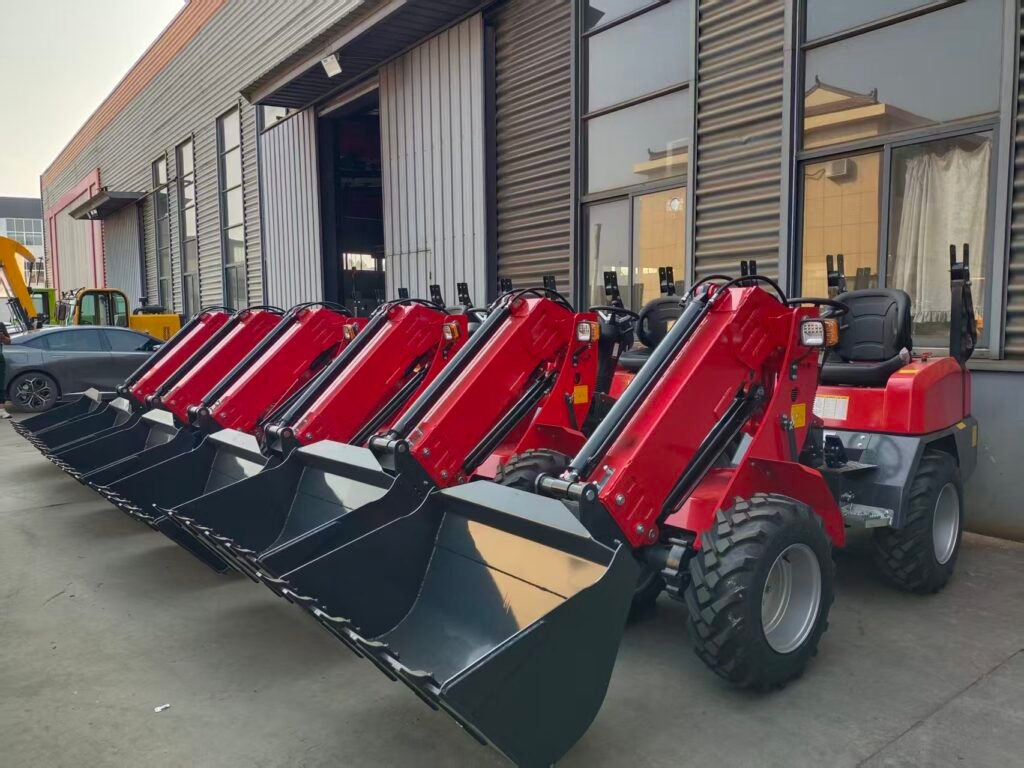
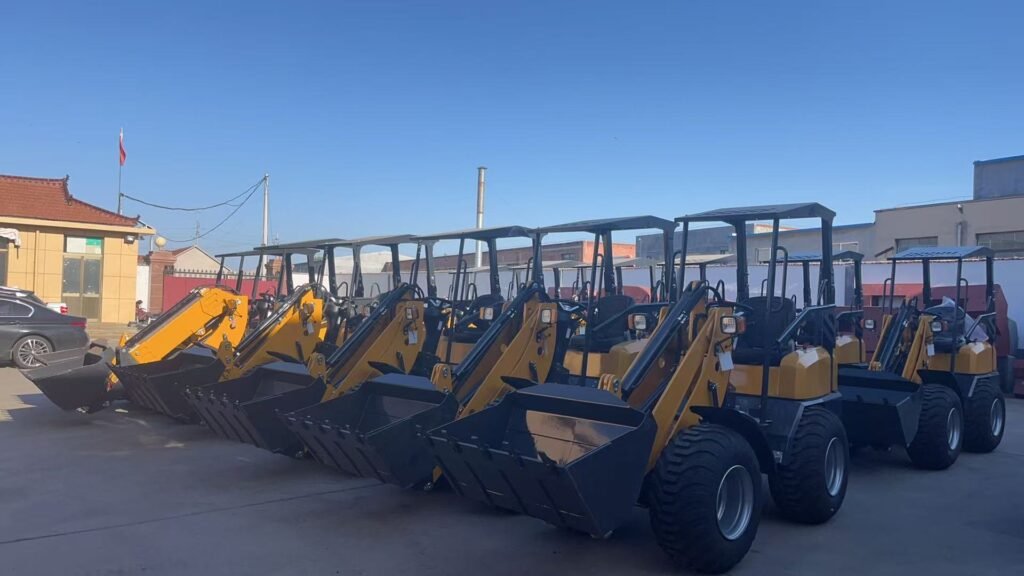
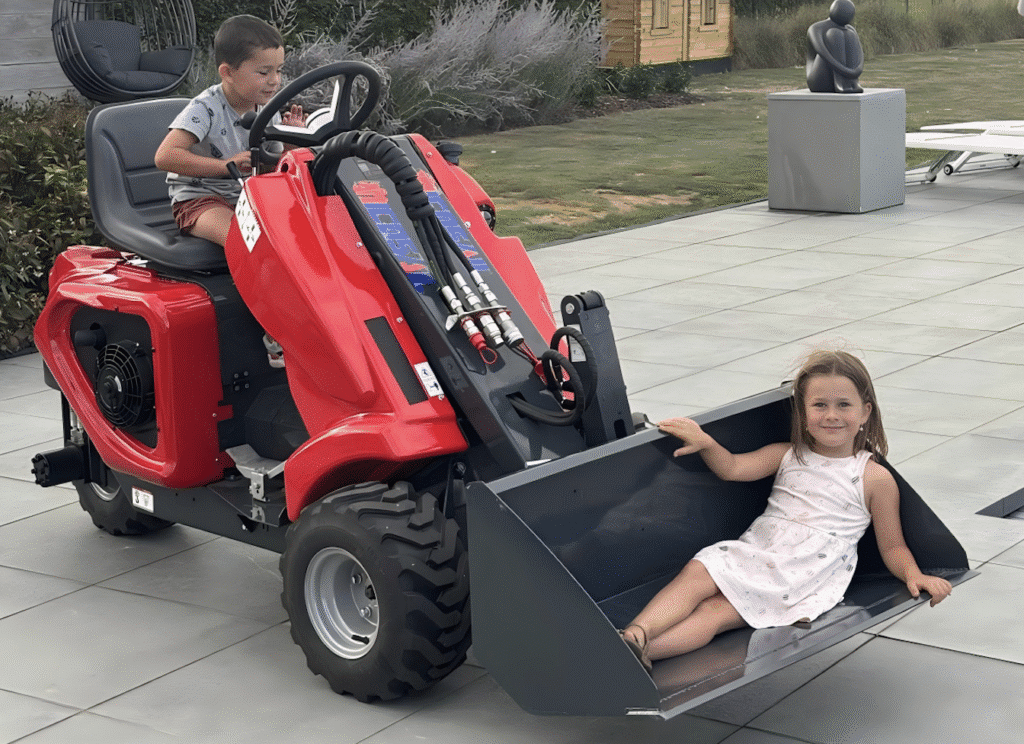
Chinese factories now specialize in compact telescopic loaders for:
Agriculture (hay, silage, grain, feed)
Small construction sites
Rental fleets
Municipal and yard work
Several Chinese manufacturers focus on compact telescopic loaders with hydraulic booms and versatile attachments for export markets.
For a dealer or importer, this machine type is attractive because:
It fills a niche (between a mini wheel loader and a telehandler)
Ticket price is manageable
Transport is easier than with large telehandlers
It can be branded under a private label relatively easily
2. Why So Many Importers Choose Chinese OEM/ODM Telescopic Loaders
Many European, North American, and Australian buyers look to China for telescopic loaders because of three big reasons:
Cost advantage – Similar performance at a significantly lower unit cost than Western brands.
Customization flexibility – OEM/ODM makes it possible to sell under a local brand with specific specs.
Factory capacity – Established factories now run multiple production lines dedicated to compact loaders and mini excavators, with OEM support built into the workflow.
Chinese brands like Nicosail focus on:
Small excavators
Skid loaders
Compact tracked loaders
Telescopic loaders
These factories typically:
Offer OEM branding services
Know CE/EPA/EURO 5 requirements
Are used to working with importers and distributors rather than end users
So for someone like a Canadian or German distributor who:
Buys low-cost machines
Rebrands them
Sells at a premium in the local market
…Chinese OEM telescopic loaders are a natural fit—as long as branding, certificates, and hydraulic specifications are handled properly from the start.
3. OEM vs ODM: Which One Fits Your Business Model Best?
Before discussing color and hydraulics, it helps to sort out OEM vs ODM. Many buyers mix these two.
3.1 OEM (Original Equipment Manufacturer)
OEM in this context: The Chinese factory has its own base machine. The importer:
Uses own brand name
Uses own logo and color
May ask for limited configuration changes (engine brand, tire type, auxiliary hydraulics, cab options, etc.)
But the core structure, boom design, main dimensions and most components are factory-standard.
Good for buyers who:
Want speed to market
Don’t want to re-engineer the machine
Just need a stable, reliable platform with their own branding
3.2 ODM (Original Design Manufacturer)
ODM here: The factory designs a model or a highly customized variant specifically for the buyer. That could include:
Special wheelbase or boom geometry
Unique cab layout or control scheme
Non-standard hydraulic systems
Special attachments as “house brand”
ODM takes more time and engineering hours and typically needs:
Higher annual volumes
A long-term cooperation mindset
For most small telescopic loader importers, OEM with moderate customization is more practical:
Lower risk
Faster lead time
Easier spare parts support
A common strategy:
Start with OEM (standard structure, custom color/branding + practical hydraulic options). After the model sells well for 1–2 seasons, then consider deeper ODM changes if really needed.
Branding is often the easiest part to change, but it can still go wrong if not managed properly.
Below are typical branding elements a factory can customize on a small telescopic loader.
4.1 Machine Logo & Decals
Common positions:
Boom sides
Engine hood / rear hood
Cab doors
Counterweight
Typical options:
Vinyl stickers / decals (most common)
Painted logo (stencil or mask, more durable but slightly higher cost)
3D plastic or metal logo badges (more premium look)
Key tips:
Provide vector files (AI, EPS, or high-res PDF).
Check maximum size and shape tolerance with the factory.
Confirm sticker material (UV resistance, outdoor-rated).
4.2 Model Name & Series Designation
Dealers often want:
Own model code (e.g., TL25, TL30 Pro)
Own series name (e.g., “FarmPro”, “UrbanLine”)
This can be:
Simple text decals
Combined with logo as one graphic set
Important note: Model logic should be easy to understand for users and after-sales. For example:
TL18 – Telescopic Loader, 1.8 t
TL25 – Telescopic Loader, 2.5 t
This makes marketing and spare parts easier later.
4.3 Data Plates & Serial Number Logic
Many importers ignore this, but it is important for:
Warranty
Local inspection
Compliance checks
Ask the factory to:
Put your brand and your company name as manufacturer or importer (depending on your legal strategy)
Clearly show serial number, rated load, weight, year of manufacture
Use corrosion-resistant plates and engraving or stamping
Some importers prefer:
Factory serial number + importer’s internal code in parallel.
A coordinated serial number logic for easier tracking.
4.4 Manuals, Stickers & Safety Labels
A professional brand image is not only about big logos.
Important items:
Operator’s manual in local language
Maintenance manual or at least a clear maintenance schedule
Safety labels with pictograms and warnings in local language
Many factories already provide English manuals for export models. Translation into German, French, Spanish, etc., can be done jointly:
Factory provides base English file
Importer arranges translation
Factory prints or supplies PDF with importer’s brand on the cover
This is a low-cost way to raise perceived value and reduce operator misuse.
5. Color Customization: RAL Codes, Paint Quality & Brand Identity
Color is usually the first thing end users notice, so it’s worth planning carefully.
5.1 How Color Customization Usually Works
Most Chinese loader factories now use:
Standard industrial colors for their own brand
RAL color system for OEM customers (or Pantone interpretation where necessary)
Typical process:
Buyer sends RAL code(s) and simple design sketch or reference photos.
Factory confirms feasibility and extra cost, especially for multi-color schemes.
First unit or pre-production batch is painted and photographed for confirmation.
Common customized areas:
Boom and main body
Chassis / frame
Cab frame and roof
Rims
5.2 Single Color vs Two-Tone Scheme
Single color:
Cheaper and simpler
Faster touch-up in the field
Good for rental fleets
Two-tone (e.g., yellow body + black boom and rims):
Stronger brand recognition
More “premium” look
Slightly higher painting complexity
Some brands even add:
Contrasting cab roof for visibility
Striping decals matching the brand identity
5.3 Paint Quality: Things Worth Asking
Instead of only asking “Can the color be changed?”, it helps to ask:
What is the painting process? (sandblasting, primer, top coat, powder or wet paint)
What is the typical paint thickness range?
Is there salt-spray or adhesion testing as part of QC?
Many Chinese factories have upgraded to:
Better surface preparation (shot blasting)
Improved primers and powder coating
This closes a lot of the gap with Western brands and makes the color not only nice-looking but long-lasting.
5.4 Branding Strategy with Color
A simple approach that works for many importers:
Use one primary color for all machines (excavators, loaders, etc.)
Keep boom in a contrasting dark color for a strong silhouette
Make safety-related items (handrails, steps) in high-visibility colors
This keeps:
Brand visible on job sites
Fleet appearance consistent
Touch-up paint management easier
6. Custom Hydraulics: Aux Circuits, Flow, Pressure & Attachments
This is where customization really affects performance and reliability. A telescopic loader is basically a hydraulic toolbox; if the hydraulic spec is wrong, attachments will underperform or even get damaged.
6.1 Core Hydraulic Components to Clarify
When talking with a factory, it makes sense to clarify at least:
Main pump type & flow
Gear pump vs piston pump
Rated flow at working RPM
System pressure
Working pressure for lift & crowd functions
Control valve
Monoblock vs sectional
Manual vs joystick / electro-proportional
Auxiliary circuits
3rd function (front)
4th function (front)
Rear hydraulics (if needed)
Hydraulic oil cooler
Size, fan type, temperature control
Many Chinese telescopic loaders already use compact hydraulic systems with dedicated coolers to handle continuous work in construction and agriculture.
6.2 Auxiliary Hydraulics for Attachments
This is often the main customization point for OEM orders.
Typical attachments for small telescopic loaders:
Pallet forks / hydraulic adjustable forks
Bale grab / grapple
4-in-1 bucket
Auger
Snow blower / snow blade
Sweeper
Each attachment type has its own requirements for:
Oil flow (L/min)
Pressure (bar)
Whether a case drain is needed
Practical advice:
Ask attachment suppliers for recommended flow and pressure.
Share that data with the loader factory so they can configure:
Aux circuit flow
Relief valve settings
Hose sizes and quick couplers
6.3 Single vs Double Aux Circuits
Many buyers start with:
One front auxiliary circuit (3rd function), for simple attachments like a grapple or 4-in-1 bucket.
But for more demanding applications, a second circuit is useful:
4th function for attachments needing rotation or extra movement
Ability to run more complex tools like some snow blowers or rotating grapples
Ordering a machine with two auxiliary functions from the factory is often cheaper and cleaner than retrofitting later.
6.4 Hydraulic Cooling & Duty Cycle
In European and North American markets, loaders often work:
Long hours
In high ambient temperatures in summer
With continuous-flow attachments
Overheating hydraulic oil:
Reduces component life
Causes performance fading
Can damage seals
So for OEM telescopic loaders, it helps to specify:
“Continuous-duty” hydraulic cooling, not just minimal cooling for short cycles.
A reasonable target oil temperature (for example, keeping working oil below a certain threshold under standard ambient conditions).
Some factories already advertise improved hydraulic cooling and higher duty cycles on their telescopic loader lines.
6.5 Brand & Origin of Hydraulic Components
High-volume Chinese machines may use a mix of:
Domestic hydraulic components, and
Selected imported brands for critical parts where needed
Importers often request:
Specific valve brands
Hydraulic hose brands
Certain quick-coupler standards
This can raise cost slightly but helps with:
After-sales part availability
Buyer confidence
Marketing (“fitted with XYZ-brand hydraulics”)
A realistic approach is to specify key components that must be branded or from a certain tier, and allow the factory to select cost-effective domestic options for less critical items.
7. How to Plan a Safe OEM/ODM Project (Step-by-Step)
A simple project flow reduces misunderstandings and delays.
Step 1 – Define Target Market & Use Case
Share with the factory:
Target countries (for emissions/certification)
Typical job use: farm work, light construction, rental, snow, etc.
Expected annual volume
This helps the factory choose:
Engine type (EPA, EU Stage V, etc.)
Base model size (1.6t, 2.0t, 2.5t class, etc.)
Step 2 – Lock in Base Model
Select a base telescopic loader model that already:
Has stable performance in other markets
Has a known load chart and working range
Uses engine and hydraulic components that can pass local compliance
Insist on:
Basic spec sheet
Load chart (if available)
Basic dimensions and turning radius
Step 3 – Branding & Color Proposal
Provide:
High-resolution logo files
RAL color codes
Simple layout: where the logos and texts go
Ask the factory to:
Provide 3D renderings or photos of one painted sample (even photo mockups can help)
Confirm if any extra painting cost applies
Step 4 – Hydraulics & Attachments
Send the factory:
List of attachments planned for sale with the loader
Required flow/pressure for each key tool
Ask them to:
Propose aux hydraulic configurations (number of circuits, flow, valves)
Confirm that pump and cooler can support those attachments for realistic duty cycles
Step 5 – Pre-Production Sample or Pilot Order
For first order:
Many importers start with 1–3 units as pilot machines.
These are used for internal testing and demo to key customers.
Request:
Detailed inspection report
Photo and/or video of critical welding areas, hose routing, boom structure, etc.
Step 6 – Local Testing & Feedback
Before placing a large order:
Run the machine in real jobs: farm, yard, construction site.
Collect feedback on:
Stability under load
Boom stiffness
Hydraulic response and heat
Operator comfort
Any issues can be fed back to the factory for adjustment (hydraulic valve tuning, hose protection, boom damping, etc.).
Step 7 – Scale Up with Stable Specs
Once the machine behaves well and the branding looks good:
Freeze the specification
Use a standard options list for dealers to select from
Lock in annual or seasonal purchase plan with the factory
This allows:
Stable production
Better cost control
Easier spare parts stocking
_cuva
8. Cost & Lead Time: Where Customization Really Adds Up
Not all customization has the same impact.
Low-Impact (Cost & Time) Customizations
Logo decals and basic branding
RAL color change (single color)
Minor options: work lights, beacon, tire pattern
These usually:
Add small cost per unit
Have minimal effect on lead time once set up
Medium-Impact Customizations
Two-tone paint scheme
3rd and 4th hydraulic functions with specific valves
Non-standard quick couplers and hose fittings
Upgraded seats, cab options, or joystick controls
These may:
Require additional design & installation work
Need more detailed QC
Slightly extend production lead time
High-Impact Customizations
Structural changes (boom length, frame extension)
Completely different hydraulics (pump type, major layout changes)
Alternative engines not previously used in that model
These touch safety, stability, and certification; they are ODM-level and should only be done with:
Clear engineering drawings
Load testing
Possibly third-party certification
For many importers, the smart strategy is:
Maximize branding & color customization, plus smart hydraulic options, keep the structure largely standard.
This gives a machine that feels unique in the market, while staying inside the manufacturer’s proven design envelope.
9. Risk Control: How to Avoid Common OEM/ODM Pitfalls
Buyers often share similar complaints:
Delayed shipments → missed selling season
Certificate “mistakes” or poor documentation
Hydraulics not matching the promised spec
Some practical ways to reduce these risks:
9.1 Clarify Certification & Compliance Early
For each target market:
Confirm if CE, EPA, or other local standards are required.
Ask for sample certificates and test reports early in the discussion.
Reputable factories working with Europe and North America are used to preparing the right export documentation.
9.2 Written Specification Sheet
Instead of “Yes, we can” in emails, insist on a final spec sheet, covering:
Engine brand and emission level
Major hydraulic components
Auxiliary circuit parameters
Tire size
Dimensions & weights
Branding & color scheme
Both sides can sign or stamp this spec as a reference.
9.3 Pre-Shipment Inspection
Two common approaches:
Third-party inspection service visits the factory
Detailed photo & video inspection protocol agreed in advance
Check especially:
Paint finish and color correctness
Decals & logos
Hose routing and clamp quality
Welding in high-stress joints
Cab finishing and electrical wiring
9.4 Spare Parts & After-Sales
Before confirming an order:
Request recommended spare parts list for the first year
Arrange a starter parts package to ship with the first batch
This reduces downtime for early customers and builds trust in the new brand.
10. How a Factory Like Nicosail Typically Supports OEM Telescopic Loaders
To make things more concrete, consider how a specialized Chinese factory such as Nicosail is positioned.
Publicly available information shows that Nicosail:
Operates multiple production lines for small excavators and loaders
Focuses on B2B cooperation with agents, importers, and distributors
Offers OEM branding services, including color and logo customization
For compact telescopic loaders, such a factory typically:
Provides a standard product range of small hydraulic telescopic loaders designed for export
…working with a factory in this category is usually easier than starting from a general small workshop with no export experience.
The key is still the same:
Clear specs,
Step-by-step testing,
Transparent communication on hydraulics and certification.
11. Practical Specs Checklist for Your Next Chinese Telescopic Loader
Here is a compact checklist that many importers use when discussing with a Chinese OEM/ODM factory.
11.1 Basic Machine Parameters
Operating weight
Rated load at full boom extension
Max lift height (pin & bucket bottom)
Engine brand & emission level (EPA/Stage V etc.)
Transmission type (hydrostatic / torque converter)
11.2 Hydraulics
Pump type (gear/piston) and flow at rated RPM
System working pressure
Number of auxiliary circuits (front & rear)
Aux flow and pressure
Oil cooler size and fan type
11.3 Structure & Chassis
Wheelbase
Overall width and height (transport and with boom lowered)
Tire size and type
Articulation angle and turning radius
11.4 Cab & Controls
Open canopy vs enclosed cabin
Heating / air-conditioning availability
Joystick control vs levers
Seat type and safety belt
11.5 Branding & Color
RAL code for main color
RAL code for boom, rims, cab
Logo placement and size
Data plate content and layout
11.6 Documentation
Operator manual language(s)
Parts list
CE/EPA certificates or declarations
Inspection reports (if applicable)
Having this list in a single document greatly reduces back-and-forth emails and improves the chance that the first batch arrives exactly as expected.
12. FAQ: Real Questions Buyers Usually Ask
Q1: What is a realistic minimum order quantity (MOQ) for OEM branding?
For branding and color only, many factories are willing to support very small MOQs, especially if they already produce similar machines for other markets. The MOQ often depends more on logistics and paint changeover cost than on any hard technical limit. For deeper redesign (ODM), higher annual volumes are usually expected.
Q2: How much longer does custom color and logo add to lead time?
Once the design and RAL colors are confirmed and the factory has set up the process, custom colors usually add only a small amount of extra time. The bigger time driver is the first order, because paint, decals, and manuals need to be prepared. After that, OEM machines can normally be produced within the factory’s regular lead time window.
Q3: Can the hydraulics be customized to match my existing attachment fleet?
Yes—within limits. A factory can typically adjust:
Number of aux circuits
Flow and pressure
Hose and coupler types
However, there is still a performance envelope determined by pump size, engine power, and cooling capacity. If very high-flow tools are needed, it might be better to select a larger base machine rather than over-stressing a small telescopic loader.
Q4: How to make sure the machine really meets CE or EPA requirements?
Reliable factories already export to regulated markets and should be able to provide:
Certificates and declarations
Emission documentation for the engine
Sometimes test reports
It is wise to:
Request these documents before signing a major order
Have them checked by a local compliance expert if needed
Q5: What about long-term spare parts availability for an OEM-branded machine?
To protect the local brand and reduce downtime:
Agree on a minimum support period for key parts (for example, several years after last delivery).
Request a recommended spare parts list.
Consider stocking a starter kit of wear parts.
Choosing a factory that sticks to widely available engines and hydraulic components also makes long-term support easier.
Q6: How can an importer avoid “over-customizing” and creating a one-off machine?
A simple rule is:
Keep core structure and major systems standard,
Customize branding, color, and practical hydraulic options.
This keeps most parts common with other machines the factory produces, which is good for both reliability and spare parts availability.
Q7: Is it possible to use the same brand and color on mini excavators and telescopic loaders?
Yes, and this is actually a strong strategy. Many factories like Nicosail produce both mini excavators and loaders, so aligning color and branding across both product lines is usually straightforward.
13. Final Summary: 80% Standard + 20% Custom Is Usually the Sweet Spot
For distributors, rental companies, and importers looking at Chinese small telescopic loaders as an OEM/ODM opportunity, the most effective approach is usually:
Use a proven base machine from a factory experienced in export.
Apply strong branding and color customization to build market identity.
Configure hydraulics smartly to match local attachments and working conditions.
Keep structural and deep technical changes controlled and step-by-step, starting from OEM and only moving toward full ODM when volumes are clear.
Factories such as Nicosail, with established production lines for compact machinery and experience in OEM services, show how Chinese manufacturers have moved beyond just “cheap machines” to flexible, brand-supporting partners for global buyers.
With a clear specification sheet, realistic expectations, and a focus on 80% standard + 20% custom, importers can:
Reduce technical risk
Speed up time to market
Build a recognizable local brand
Keep after-sales service under control
The result is a telescopic loader line that looks like “your own machine” in the market, but is backed by the manufacturing experience and infrastructure of a Chinese factory that builds these machines every day.
Ask For A Quick Quote
We will contact you within 1 working day, please pay attention to the email with the suffix “@nicosail.com”.
Note: Your personal information will be kept strictly confidential.