
1. What Is a Small Telescopic Loader and Why It Rents So Well
A small telescopic loader (often called a compact telehandler or small tele loader) is basically:
- The body and maneuverability of a compact loader
- Plus a telescopic boom that can lift loads much higher and further forward than a normal loader arm
For rental fleets, small telescopic loaders are popular because they can work in:
- Agriculture – handling bales, loading feed, stacking in barns
- Construction – lifting pallets of bricks, blocks, roofing materials
- Landscaping & garden centers – loading bulk materials, stacking pallets
- Warehousing & industrial yards – outdoor stacking where forklifts struggle
Users like them because one machine can:
- Load trucks
- Stack high
- Work in tight spaces
- Be moved between jobs easily (small trailer or truck)
That combination makes them high-rotation rental machines, especially when sized correctly (small to mid-range).
2. How Rental Companies Typically Use Chinese Tele Loaders
When small telescopic loaders come from Chinese factories, rental companies usually use them in two main ways:
- Core fleet machines – standard models that go out constantly:
- Fixed spec
- Simple attachments (bucket, pallet forks)
- Rented to construction, farms, and small contractors
- Niche or “gap filler” machines – to cover segments where premium Western brands are too expensive to buy:
- Slightly smaller or larger size than the main fleet
- Special attachments (grapple, bale clamp, light material bucket)
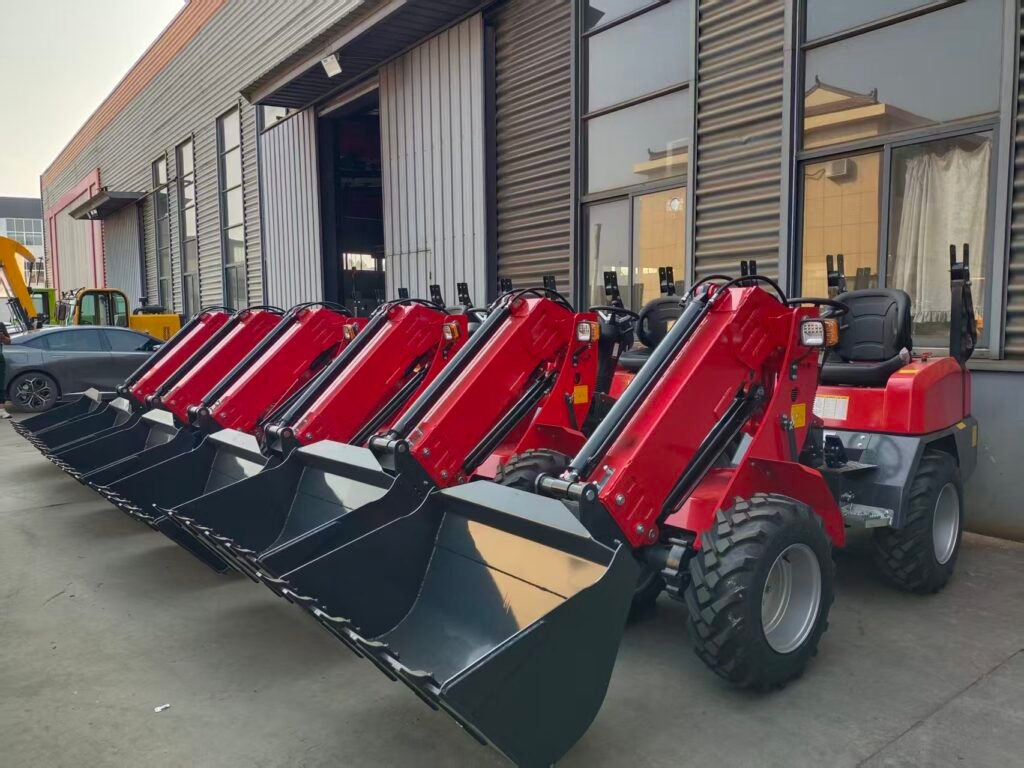
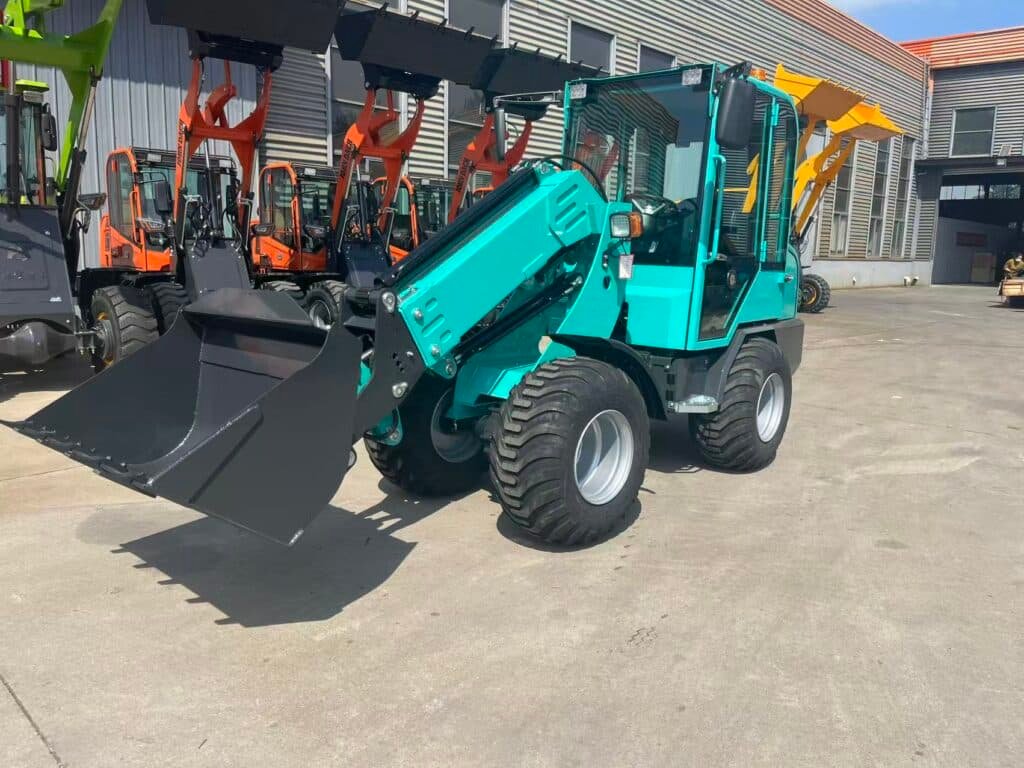
Because factories like Nicosail can customize appearance and some specifications (color, decals, optional attachments), many distributors:
- Order them in their own brand color
- Put their company logo on the machine
- Promote them as part of their in-house rental+sales lineup
This way, the machine appears fully integrated into the local rental fleet, even though the iron comes from China.
3. Utilization: The Real Driver of Rental Profit
In rental, utilization is king. A cheap machine that sits in the yard is still expensive.
There are two main types of utilization:
- Time utilization – how many days or weeks per year the machine is out on rent
- Hour utilization – how many engine hours it works per year
For small telescopic loaders, both matter.
3.1 Annual Utilization Targets (Hours & Days)
Every market is different, but rental companies commonly aim for:
- Time utilization:
- Good: 55–65% of the year out on rent
- Excellent: 70%+ (about 250+ days per year rented)
- Hour utilization (per machine per year):
- Light use: 400–600 hours/year
- Normal: 700–900 hours/year
- Heavy: 1,000+ hours/year
If a Chinese small telescopic loader is priced competitively, it usually only needs moderate utilization to be profitable, because purchase cost is lower than a big-name Western machine.
The key is to:
- Not oversize the machine (too big for the jobs)
- Keep it busy across different customer segments (construction + agriculture + landscaping, etc.)
3.2 Matching Machine Specs to Local Jobs
Utilization is directly affected by spec mismatch. A common mistake: bringing in a machine that is too exotic or too “in between” for the local market.
For small telescopic loaders, the core specs to match are:
- Rated lifting capacity (e.g., 1.5–3.0 tons)
- Max lifting height (e.g., 4–6 meters for small units)
- Overall width and height (for working in barns, doorways, under roofs)
- Engine power / travel speed (enough for jobsite travel but not overkill)
When the spec is right:
- Construction crews can unload trucks and feed materials upstairs
- Farmers can comfortably stack bales or work in barns without hitting roofs
- Garden centers can use them in tight aisles
Brands like Nicosail often let distributors adjust some parameters (attachments, tires, cabin options), so the rental company can tailor the machine to the most common local job instead of buying a generic global spec.
3.3 Seasonal Demand and Fleet Mix
Many regions have strong seasonality:
- Spring–summer: construction and landscaping peak
- Harvest periods: agriculture peaks
- Winter: demand from construction might drop, but indoor / barn work continues
To keep utilization steady across the year:
- Some rental companies market the same tele loader differently by season
- Summer: “compact telehandler for building sites”
- Autumn: “farm loader for bale handling”
A small machine from a flexible Chinese manufacturer can be equipped with:
- Forks and bucket for construction users
- Grapple or bale spike for farmers
One machine, multiple markets, smoother utilization.
4. Setting Rental Rates That Actually Make Money
Rental rate is not just “what competitors are charging minus 10%”. It should be built backward from cost and target utilization.
4.1 Cost Structure: What Must the Rate Cover?
For a Chinese small telescopic loader, the main cost components are:
- Purchase cost (machine + attachments + freight + import cost)
- Financing cost (interest if purchased with a loan)
- Depreciation (loss in value over its rental life)
- Maintenance & repairs (filters, oil, tires, hoses, unexpected repairs)
- Insurance & registration (if applicable)
- Overheads (yard, staff, marketing, transport truck share)
A smart rental rate aims to:
- Recover full machine cost + profit within a certain period (e.g., 3–5 years)
- Cover all operational costs
- Leave a margin for risk (bad payers, accidents, downtime)
Because the purchase price of a Chinese tele loader is usually lower, the rental company has more flexibility:
- Either charge market-level rates and enjoy higher margins, or
- Price slightly below competitors (who are using premium Western brands) and gain market share while still making healthy profit.
4.2 Building a Day / Week / Month Rate Ladder
Most rental companies use a rate ladder like this:
- Daily rate – for 1–2 day jobs
- Weekly rate – often ~3–4 times the daily rate
- Monthly rate – often ~2.5–3 times the weekly rate
This encourages customers to keep the machine longer, which improves utilization and reduces handling (delivery, pickup, paperwork).
Example structure for a small tele loader:
- Daily: 100 units (currency)
- Weekly: 350–400 units
- Monthly: 900–1,100 units
Exact numbers depend heavily on:
- Local market prices
- Machine size and spec
- Demand (high or low competition)
The important part is consistency:
- The monthly rate should still cover cost if the machine is out for several months
- Short-term rentals should carry a premium because of more logistics & risk
4.3 Daily vs. Hour Meter: How to Control Overuse
Small tele loaders can be abused with very long working days by some customers.
Two common approaches:
- “Time-based” rental only (per day/week/month, no formal hour limit)
- Simple, easy to understand
- Risk: heavy users put 10–12 hours per day on the machine
- Time + hour limit
- Example: daily rate includes up to 8 hours on the hour meter
- Extra hours are charged at a fixed “overtime” rate
Many rental companies choose a middle road:
- Keep the contract wording with an hour limit
- Use hour meter readings to protect against extreme abuse or disputes
- But in practice, small extra overrun (e.g., 1–2 hours) is often tolerated
Chinese machines like those from Nicosail usually come with simple, reliable hour meters and can be equipped with basic GPS/telemetry if needed, which helps track real usage.
4.4 Example Rate Calculations for a Chinese Small Telescopic Loader
Let’s walk through a simplified example. (Numbers are illustrative only; each market is different.)
Assume:
- Purchase cost CIF, fully landed: USD 35,000
- Planned rental life: 5 years
- Expected utilization: 800 hours/year, or 200 rental days/year
- Target gross revenue: at least 2.5–3.0× purchase cost over 5 years
Target total rental revenue:
- Minimum target = 35,000 × 2.5 = USD 87,500 over 5 years
- Per year = 87,500 ÷ 5 = USD 17,500 per year
If the machine is rented 200 days per year, the average daily revenue needed is:
- 17,500 ÷ 200 = USD 87.5 per rental day
So if the rental company sets:
- Daily: USD 110–120
- Weekly: USD 390–420
- Monthly: USD 1,000–1,200
Then:
- At 200 days/year, revenue will exceed the target
- Extra revenue covers over-run in maintenance or any downtime
- If utilization is higher than expected, profit increases sharply
Because a Chinese machine’s initial cost is lower than many Western-brand telehandlers, these numbers are often achievable even when pricing slightly under big-brand rental competitors.
5. Damage Waivers & Insurance: Protecting the Machine and the Business
A damage waiver is one of the most misunderstood parts of rental. It’s important both for the rental company and for the customer.
5.1 What Is a Damage Waiver in Equipment Rental?
In simple terms, a damage waiver is:
An extra fee paid by the renter so that, if the machine is accidentally damaged, they don’t have to pay the entire repair or replacement cost.
It is not always an insurance policy in the legal sense; it is usually a contractual agreement between rental company and customer.
For telescopic loaders, damage can be expensive:
- Boom damage
- Overload-related structural cracks
- Broken glass and doors
- Bent attachments
So a structured damage waiver policy protects:
- The rental company (cash flow, reduced unpaid damage)
- The customer (no shock bills if something goes wrong in honest use)
5.2 What It Usually Covers (and Not)
Typical damage waiver covers:
- Accidental damage during proper use
- Fire, theft (sometimes, depending on terms)
- Vandalism (sometimes)
Typical damage waiver DOES NOT cover:
- Gross negligence (e.g., driving the loader into a river)
- Intentional damage
- Misuse (using the tele loader as a crane far beyond rated capacity)
- Normal wear and tear (this is the rental company’s responsibility)
To avoid fights later, rental companies should:
- Explain in plain language at the counter or in the quote what is and isn’t covered
- Use photos before and after rental to document condition
- Have a simple check-in / check-out form (glass, lights, boom, attachments checked)
5.3 How Much to Charge for a Damage Waiver
Common approaches:
- Flat percentage of the rental rate, e.g. 10–15%
- Or fixed daily amount, added on top
Example:
- Daily machine rental: USD 120
- Damage waiver: 12% of rental rate = USD 14.40 per day
Or:
- Machine rental: USD 120/day
- Damage waiver: USD 10–20 per day flat
Pricing should be enough to:
- Cover average damage costs over time
- But not so high that customers feel “forced” and react negatively
Many rental companies:
- Make the waiver optional but strongly recommended
- Or require it for certain customers (short-term, unknown credit history)
5.4 Rental Agreements, Photos, and Checklists
Written contracts and documentation are the best friends of both sides.
For each small tele loader rental, it’s wise to use:
- Pre-rental inspection checklist
- Machine ID, hours, fuel level
- Photos of all sides + cab + attachments
- Any pre-existing damage marked
- Post-rental inspection checklist
- Repeat process, compare with original photos
- Note any new damage, obtain customer’s signature
- Clear terms about:
- Hour limits
- Cleaning / fuel charges
- Damage waiver coverage and excess (deductible)
Machines from Chinese factories like Nicosail can be shipped with custom decals and labels (including safety stickers in local language), which makes it easier to mark inspection points and damage on reports.
6. How Chinese Brands Like Nicosail Fit into a Rental Strategy
Chinese small telescopic loaders are not just about low purchase price. For rental companies, they change the math of ROI.
6.1 Purchase Price vs. Rental Return
A well-selected Chinese loader (from a factory that knows rental requirements) can:
- Cost significantly less upfront than comparable Western models
- Still deliver enough durability for 5+ years in rental, if maintained properly
For a rental company, that means:
- Lower monthly financing burden
- Faster payback period
- Ability to buy more units with the same capital, increasing fleet size
Brands like Nicosail position themselves with:
- Competitive pricing
- Factory ability to customize appearance and configuration
- A focus on export markets (Europe, North America, Australia)
For a distributor or rental company, this makes it easier to build a tele loader rental line under their own brand while keeping costs under control.
6.2 Durability and “Real-World” Reliability
Rentals are harder on machines than private owners. Machines are often:
- Operated by different people every week
- Pushed to the limit
- Not always checked daily
So reliability depends on:
- Hydraulic system quality (valves, pumps, hoses)
- Chassis and boom structure (welds, high stress areas)
- Cooling system (no overheating in summer)
- Electrical layout (simple and protected from water/dust)
Serious factories in China that understand rental – including Nicosail – usually:
- Use well-known engine brands (often with global service support)
- Choose reliable hydraulic components and simplify routing to avoid leaks
- Reinforce high-stress weld areas on the boom and chassis
- Test machines on vibration benches and on real test fields before shipping
This attention to real-world usage is what allows Chinese machines to sit in rental fleets without causing constant downtime.
6.3 Parts, After-Sales, and Keeping Downtime Low
Downtime kills rental profitability. When buying Chinese machines for rental, it is important that:
- The factory is willing to provide parts diagrams and lists
- Key wear parts (filters, seals, sensors, glass, etc.) can be kept in local stock
- There is clear communication channel for technical questions
Factories like Nicosail generally support distributors with:
- Spare parts kits for the first few years
- PDF manuals or online documentation
- Technical support for troubleshooting
For rental operators, this means:
- Faster repair turnaround
- Less idle time in the yard waiting for parts
- More reliable planning of fleet utilization

7. Practical Tips to Reduce Breakdowns and Disputes
Even the best machine can be ruined by poor use. A few simple habits can drastically reduce damage and arguments with renters.
7.1 Operator Training for Short-Term Renters
Short-term renters often say “I know how to run it,” but that doesn’t mean they know that specific model.
Good practice:
- Spend 5–10 minutes on handover:
- Show basic controls (boom up/down, extend/retract, stabilizers if fitted)
- Explain load chart and safe lifting
- Point out the max lifting height and outreach
- Show where to check oil, coolant, and fuel
- Leave a simple laminated quick guide in the cab (with pictures)
Small telescopic loaders from brands like Nicosail can be ordered with customized control labels and instructions in local language, which makes this far easier and safer.
7.2 Simple Daily Checks for Customers
Many big failures start from ignored small problems:
- Low engine oil
- Weak coolant level
- Hydraulic leaks ignored
- Clogged radiator because of dust
Rental companies can reduce issues by requiring:
- Daily walk-around by the customer:
- Check for visible leaks
- Check tires
- Check fluids (at least engine oil & coolant)
- Clean radiator grill if working in dusty conditions
Provide the customer with:
- A one-page checklist with boxes for each day
- A quick note that “ignoring these checks voids the damage waiver for related issues”
7.3 Telemetry and Hour Meters
For fleets with several small tele loaders, some rental companies install simple telematics:
- GPS track location
- Read hour meter remotely
- Set alerts for maintenance intervals
Even without advanced systems, hour meters are essential. They help:
- Plan service at correct intervals
- Spot heavy use patterns (some customers always max out the hours)
- Support discussions about damage and overuse
Most Chinese machines today accept aftermarket telematics kits easily, since electrics are standard 12V/24V and space is available in the cab or engine bay.
8. FAQs
Q1: Is a Chinese small telescopic loader really suitable for a professional rental fleet?
Yes, provided it is sourced from a serious factory that understands export and rental needs. With correct spec selection, proper pre-delivery inspection, and routine maintenance, many fleets successfully run Chinese loaders in construction and agriculture rentals.
Q2: How many years can a Chinese tele loader stay in rental before being sold?
Many rental companies plan for 4–6 years depending on utilization and environment. Machines with lower annual hours and good maintenance can stay longer or be sold as used equipment to smaller contractors or farmers.
Q3: How should a rental company compare Chinese vs Western-brand tele loaders?
Key points to compare:
- Purchase price and financing cost
- Expected resale value after 5–6 years
- Realistic annual hours in that specific rental market
- Parts availability and service support
Chinese machines from committed manufacturers often win on purchase cost and flexibility, while Western brands may hold higher resale value. The final decision should be based on total ROI, not just initial price.
Q4: What attachments are most popular for small telescopic loader rentals?
The top attachments tend to be:
- Standard general-purpose bucket
- Pallet forks
- Light material bucket (for grain, mulch, etc.)
- Bale spike or small grapple in agricultural regions
Factories like Nicosail can often supply these attachments together with the base machine, matched to the loader’s capacity.
Q5: Should the damage waiver be mandatory?
This depends on local law and business strategy. Many rental companies:
- Make it mandatory for short-term or walk-in customers
- Make it optional for large contractors who already carry their own insurance
The important thing is that the coverage and exclusions are clearly written and explained before rental starts.
Q6: How many small telescopic loaders should a new rental business start with?
For a new fleet, starting with 1–3 units of a well-chosen core size is common. Once utilization data is clear (e.g., consistently above 60–70%), more units or other size variants can be added.
Q7: How does Nicosail specifically support rental companies?
Nicosail typically offers:
- Small telescopic loaders designed with export and rental in mind
- Customizable colors and branding so machines match local fleet identity
- Assistance with spare parts kits, manuals, and technical support
- Flexible configuration options (cab, lighting, attachments) to match local jobs
This makes it easier for distributors and rental companies to integrate Chinese tele loaders into a professional fleet without them feeling like “outsiders” in the lineup.

9. Final Summary
Small telescopic loaders are excellent high-utilization rental machines when:
- Specs are matched properly to local jobs
- Utilization is planned across seasons and customer segments
- Rental rates are built from costs, not just competitors’ price lists
- Damage waivers and rental terms are clear and documented
Chinese-made small tele loaders, when chosen from reliable manufacturers like Nicosail, can dramatically improve the return on investment for rental companies:
- Lower acquisition cost
- Faster payback period
- More flexible fleet growth
By combining a well-selected Chinese machine with smart utilization planning, solid pricing, and clear damage waiver policies, rental businesses can build a profitable, low-headache telescopic loader segment that keeps customers happy and machines working, not sitting in the yard.